PersonalAugust 21, 2024
Dot Connect Game
A browser puzzle game with random boards, graph-search solvers, and a persistent leaderboard.
- Web interface
- API
- Game Development
- Software Engineering
- Node.js
- React
- Tailwind CSS
- Go
- JavaScript
The puzzle
Dot Connect asks the player to start at a marked cell and visit every usable dot exactly once by moving horizontally or vertically. Blocked cells are excluded, so a board can be modeled as a graph whose vertices are usable cells and whose edges represent adjacent moves.
Solvers and board model
The Go backend converts a board into that graph and runs a pre-check for isolated cells and excessive endpoints before attempting a solution. The brute-force solver recursively explores legal neighbors and backtracks when a partial route cannot visit every dot. A second solver orders candidate neighbors by how many onward connections remain, trying the more connected options first.
if len(currPath) == usableDotCount {
    return currPath, true
}
This is the recursive search's completion condition: a route succeeds once it contains every usable cell. The same graph representation lets the project compare exhaustive exploration with a heuristic ordering rule.
Web application
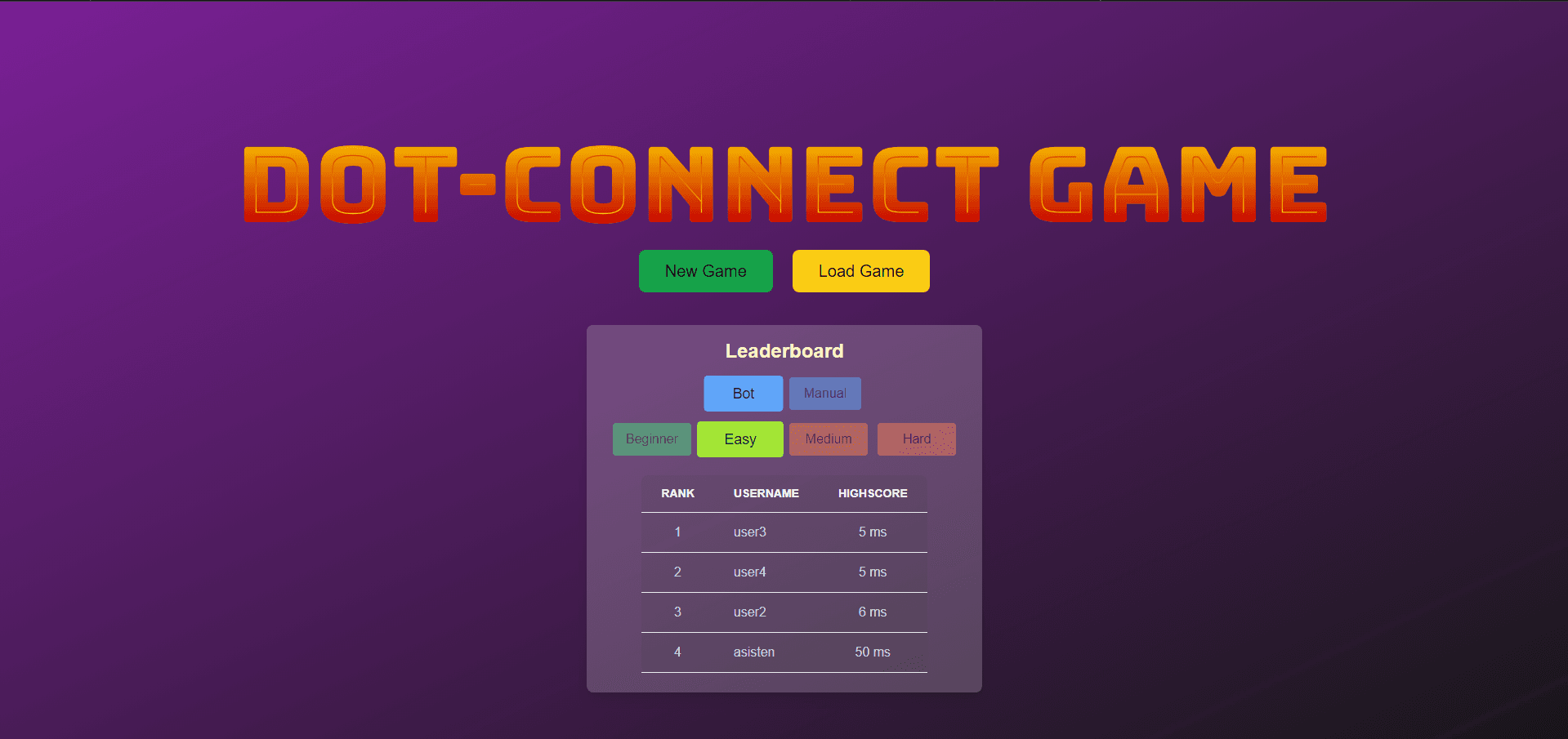
The React and Tailwind CSS frontend presents the puzzle and communicates with a Go API built on Gin. The app also includes random board generation and a leaderboard backed by SQLite.
Board cells -> Graph nodes and edges -> Solver -> Route shown in the game
                                      |
                                      +-> SQLite leaderboard
Building the project connected graph theory and backtracking to an interactive interface, API boundaries, and persisted game results. It also highlighted a useful distinction: ordering the search can help find a route sooner, but a heuristic is not itself proof that a board has a solution.