AcademicNovember 4, 2024
Perfect Magic Cube Solver
A Python GUI for comparing local-search strategies on a five-by-five-by-five magic-cube puzzle.
- GUI
- Artificial Intelligence
- Mathematics
- Optimization
- Python
- AI
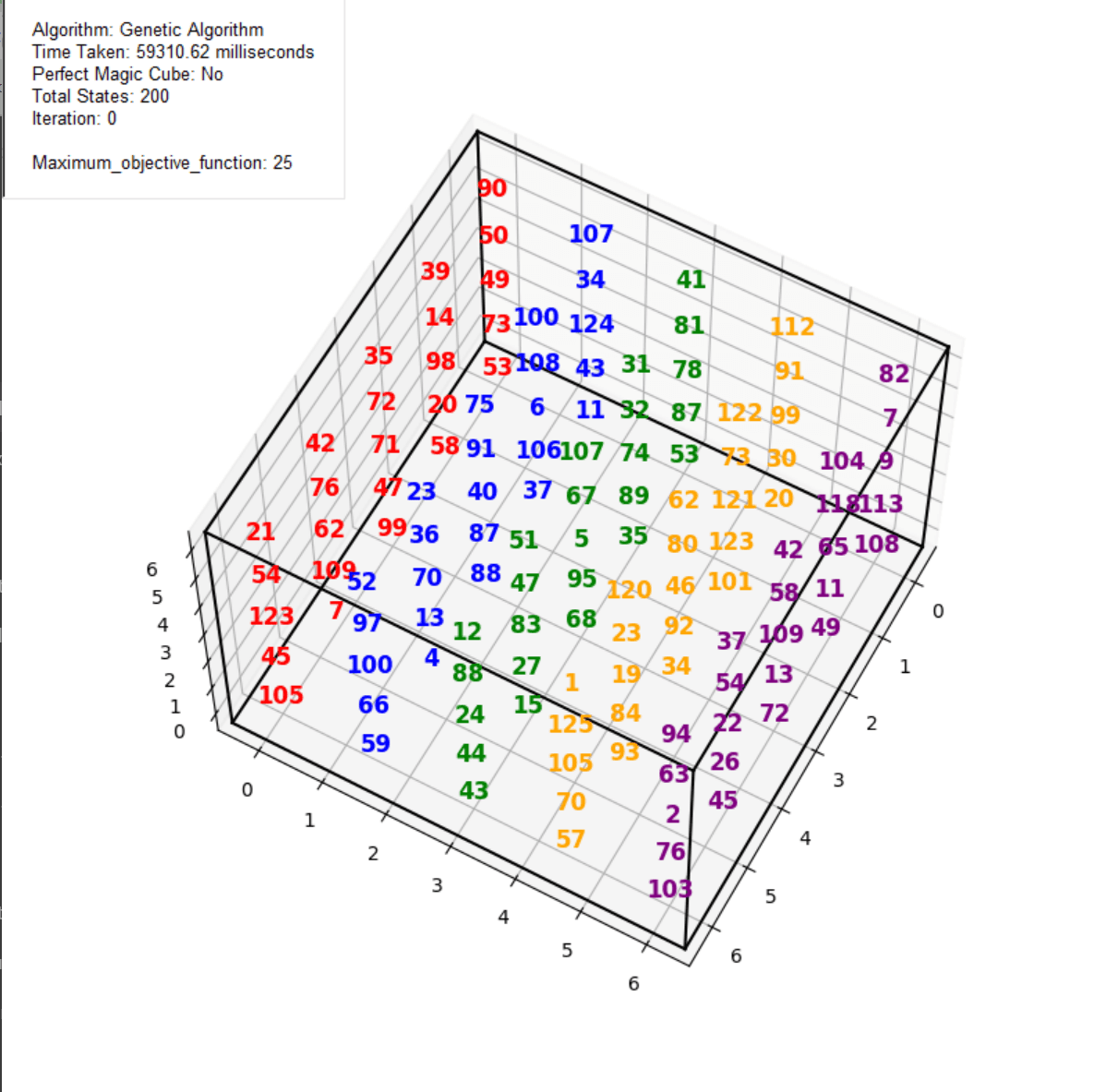
The puzzle
This Python program searches for a perfect magic cube by rearranging values in a three-dimensional grid and checking the sums of its required lines. The implementation defaults to a 5×5×5 cube with a target line sum of 315. The repository README describes a 3×3×3 puzzle, but the code's default cube size and objective function implement the larger puzzle, so this page follows the source behavior.
Scoring candidate cubes
The objective function counts rows, columns, pillars, and the implemented diagonal lines whose sums do not equal the target. It converts that count into a score where 109 represents a cube with no failing lines. This gives the search methods a shared way to compare candidate arrangements.
return 109 - ObjectiveFunction.__check_315(magic_cube)
Comparing local search methods
The program includes steepest-ascent, stochastic, sideways-move, and random-restart hill climbing, as well as simulated annealing and a genetic algorithm. These methods explore neighboring arrangements in different ways. For example, hill climbing favors improving moves, while simulated annealing can sometimes accept a lower-scoring neighbor based on a temperature-dependent probability.
A small GUI lets a user choose a search method and watch recorded cube states in a visualization with video-like controls. That made it possible to connect the abstract search process to changes in the candidate solution over time.
Create or choose an initial cube
             |
             v
      Score its line sums
             |
             v
Select a local-search method
             |
             v
Generate and score neighbor states
             |
             v
Show the search history in the GUI
The project helped me compare optimization strategies against one objective function and see how evaluation design shapes a search problem.