AcademicJune 12, 2024
Shape Side Matching for Rectangular Shape Origin
A Python image-matching experiment that represents shape edges as sequences and combines exact search with edit-distance similarity.
- Script
- Algorithms
- Computer Science
- Mathematics
- Python
- NumPy
Representing a shape side
This program tests a method for matching the sides of shapes in images. It scans each image from a selected edge, records the distance to the first non-black pixel along each row or column, and normalizes those distances by subtracting the minimum. The resulting sequence describes the outline relative to that side and can be converted into a string for matching.
Exact and approximate matching
The matcher divides the encoded outline into short subpatterns and searches candidate dataset sides with Knuth-Morris-Pratt (KMP) or Boyer-Moore (BM). It counts how many subpatterns match each candidate. If one candidate has a unique count above the implementation's threshold, it returns that side; otherwise it falls back to a normalized Levenshtein similarity score.
if max_count > 6:
    if len(best_matches) == 1:
        return best_matches[0]

return ShapeMatching.shape_match_ld(img_path, side, dataset_pattern)
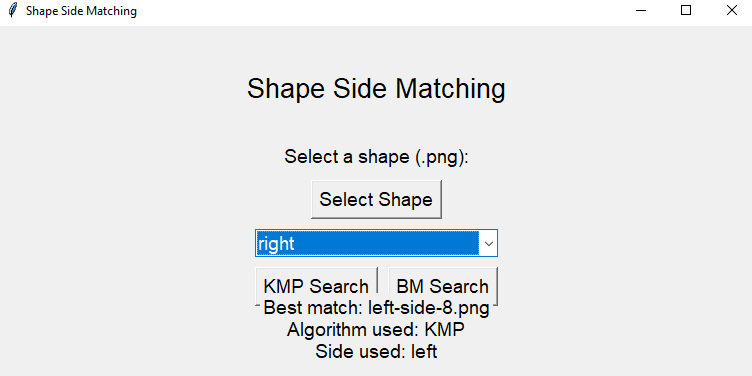
The image-processing code, pattern construction, string-matching algorithms, and simple results GUI are separate parts of the Python program. That separation made it easier to compare exact substring matching with edit distance on image-derived data.
Learning goals
The project gave me a way to apply string-search algorithms to a representation extracted from pixels instead of hand-written text. It also showed why an approximate similarity measure can help when exact pattern matches are ambiguous or incomplete.
Further reading: Application of String Matching and String Similarity for Shape Side Matching.